- Home
- Pricing
- About Us
- Partners
- Jobs
- Contact Us
- All in One Data Platform
- Fully Customizable
- Adaptable Widgets
- Process Integration
- AI Integration
- Hardware & Software Integration
- Top Tier Security
- User Friendly Interface
- Professional & Speedy Support
- Data Centers
- Barcode/QR Code System
- articleElectronic Lab Notebook (ELN)
- inventory_2Inventory Management
- scienceLaboratory Information Management Systems (LIMS)
- calculateFormulation Management
- yardAgricultural Research Manager (ARM)
- health_and_safetyQuality Management System (QMS)
- businessBusiness Development
- todayProject Management
- attach_moneyFinancial Management
- descriptionReference Management
- differenceOther Applications
- Biotech and Pharmaceutical Companies
- Contract Research Organizations (CROs)
- Clinical Products/Services for Physician Office
- Agricultural Research Companies
- Build Any SaaS Application in Minutes with AI
- Login
- Free signup
- Request a demo
- Referral Program
- Subscribe to our newsletter
- Documentation
- Blogs
- Resources
- Screenshots
- Downloads
- Terms of Service
- Privacy Policy
Agricultural Research Solutions for Crop Trial Testing
Transform Your Agricultural Product Trials with Labii's Agricultural Research Manager
Managing Complex Crop Trials Shouldn't Require Multiple Systems and Manual Spreadsheets
Agricultural research companies face unique challenges: coordinating multiple trial sites, ensuring proper randomization protocols, collecting field observations across dispersed locations, and generating comprehensive reports for stakeholders. Traditional methods involving disconnected spreadsheets, paper forms, and separate analysis tools create data silos, increase error rates, and slow down your research timeline. Your team needs a unified system that works as hard as you do—from the laboratory to the field and back.
Why Traditional Crop Trial Workflows Slow Research Down

Agricultural research teams face critical challenges that undermine trial efficiency and data quality. Fragmented spreadsheets scattered across sites create version control chaos and make cross-trial analysis nearly impossible. Inconsistent protocols between locations introduce variables that compromise statistical validity. Delayed data collection from paper-based field notes means weeks pass before issues surface—often too late to correct. Limited visibility into multi-site trials prevents timely interventions when conditions change. Manual data entry doubles workload and multiplies error rates. The result? Research teams spend more time reconciling data than analyzing results, product advancement decisions get delayed by months, and the cost per trial steadily climbs while confidence in outcomes declines.
One Platform for Designing, Running, and Analyzing Field Trials
Labii's Agricultural Research Manager unifies every phase of crop trial testing in a single, scientifically rigorous platform. Design trials with built-in randomization methods that ensure statistical validity from day one. Execute field operations with mobile-ready data capture that works offline and syncs automatically when connectivity returns. Manage sites, plots, treatments, and observations with complete traceability—every data point links back to its source protocol, operator, and timestamp. Standardize protocols across locations while accommodating site-specific variables. Generate cross-trial reports instantly with pre-built analytics that surface treatment effects, environmental correlations, and statistical confidence measures. From trial initiation through final regulatory submission, maintain a complete audit trail that satisfies GLP requirements and internal quality standards.
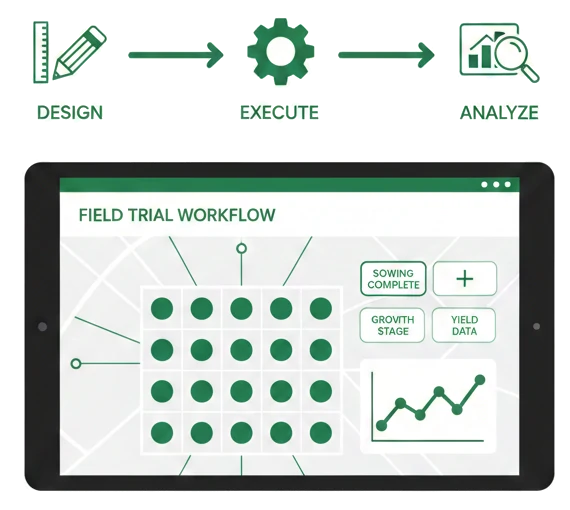
Built for Scientific Rigor and Operational Scale
Trial Design & Randomization: Configure multi-factor experiments with built-in support for randomized complete block design (RCBD), Latin square, split-plot, and custom layouts. The system validates plot assignments and prevents common design errors before fieldwork begins.
Treatment Management & Protocol Compliance: Define treatment protocols with precise application rates, timing windows, and method specifications. Track actual vs. planned applications with variance alerts that flag deviations in real time. Mobile field teams see exactly what to apply, when, and how—reducing training requirements and protocol drift.
Observation Templates & Quality Control: Build standardized data collection forms with field validation rules, measurement units, and acceptable ranges. Capture growth stages, disease ratings, yield components, and quality metrics with dropdowns, numeric inputs, and photo documentation. Automated quality checks flag outliers and missing data before teams leave the field.
Multi-Site Coordination & Reporting: Monitor trial status across all locations from a single dashboard. Compare treatment performance by site, identify environmental interactions, and generate publication-ready tables and figures. Export datasets for statistical software or use built-in ANOVA, means separation, and regression tools. Every feature balances ease of use for field technicians with analytical depth for research leads.
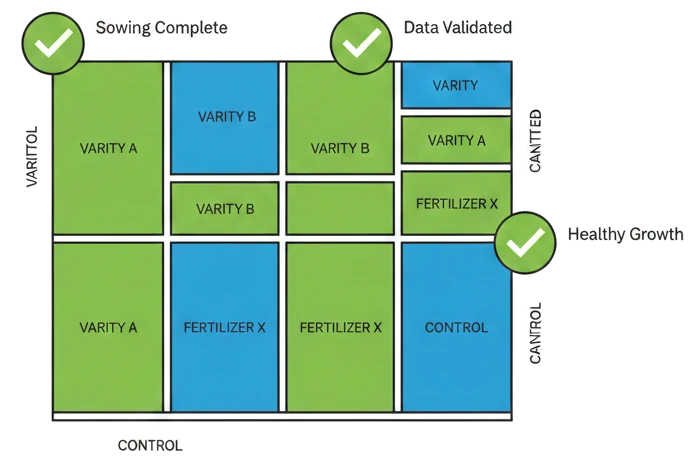
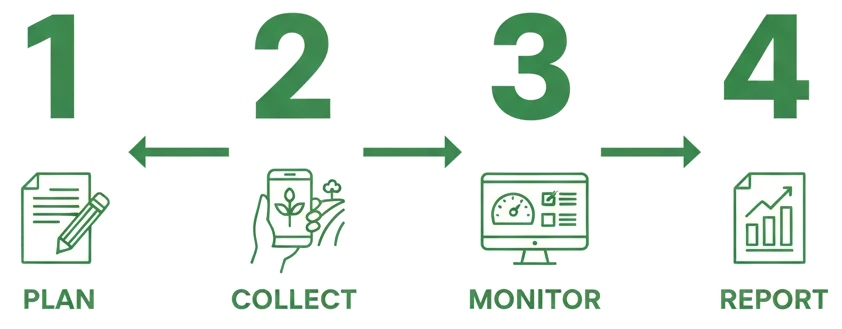
From Trial Setup to Actionable Insights in Four Steps
Step 1: Design Your Trial—Start by defining your experimental objectives, selecting crops and varieties, and specifying treatment factors. The system guides you through randomization options appropriate for your design complexity and site characteristics. Map field layouts with geo-coordinates, set plot dimensions, and assign unique identifiers. Configure observation schedules aligned with growth stages and treatment timing. Review the complete trial plan with automated validation checks before anyone enters the field.
Step 2: Execute in the Field—Equip field teams with mobile devices running the Labii app. Technicians follow guided workflows that show exactly which plots to treat, what to apply, and how to measure. Capture data directly into structured forms with automatic timestamps and GPS coordinates. Take photos, record voice notes, and scan barcodes—all linked to specific plots and observation dates. Offline mode ensures data collection proceeds even in areas without network coverage.
Step 3: Monitor & Quality Control—As data syncs from the field, supervisors see real-time progress dashboards showing completion rates, variance alerts, and data quality scores. Review flagged observations, request clarifications, and approve datasets before analysis. Compare site conditions, track weather events, and document anomalies that might affect interpretation.
Step 4: Analyze & Report—Generate statistical summaries with treatment means, standard errors, and significance tests. Create visualizations including bar charts, line graphs, and heat maps. Export clean datasets for specialized statistical software or use built-in tools for common analyses. Produce standardized reports for internal reviews, regulatory submissions, or publication—complete with methods sections that document your exact trial protocols and data handling procedures.
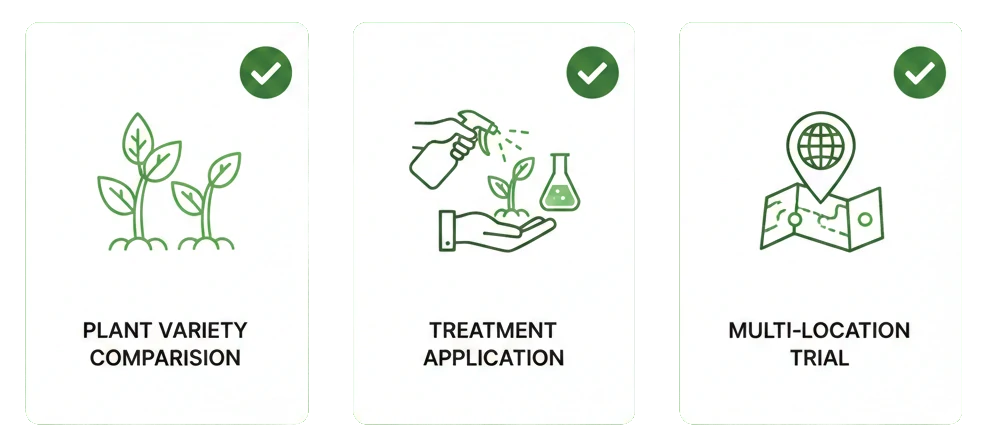
Proven Across Crop Programs, Geographies, and Trial Types
Variety Performance Trials: Evaluate new cultivars across multiple environments with standardized yield assessments, quality metrics, and disease resistance ratings. Compare candidates side-by-side with statistical confidence, identifying superior performers faster and reducing advancement cycles. Teams report 40% reduction in time from initial screening to final selection decisions.
Fertilizer & Treatment Optimization: Test nutrient formulations, application rates, and timing strategies with precise plot-level tracking. Measure crop response through growth parameters, tissue analysis integration, and final yield impacts. Built-in dose-response curves and economic analysis tools help determine optimal recommendations for commercial rollout. Research directors cite improved protocol consistency across sites as the top benefit for multi-location treatment studies.
Disease & Pest Resistance Research: Document pathogen pressure, symptom progression, and treatment efficacy with photo documentation and standardized rating scales. Link field observations to laboratory diagnostic results from integrated LIMS. Track resistance development over seasons and breeding generations. Plant pathologists value the complete data lineage from field symptoms through laboratory confirmation to genetic markers.
Multi-Location Agronomy Programs: Coordinate large-scale trials across diverse climates, soil types, and management practices. Standardize methods while capturing site-specific environmental data that explains treatment interactions. Regional coordinators maintain oversight of dozens of concurrent trials, identifying issues early and ensuring data quality before analysis. Organizations running national programs report 60% faster data compilation and dramatically improved cross-site comparability.
Trusted by Agricultural Research Teams That Need Reliable Results
Agricultural research organizations worldwide rely on Labii to manage complex field trial programs with confidence. A leading seed company reduced trial cycle times by 35% while improving data quality scores by 50%, enabling faster variety releases to market. A crop protection manufacturer standardized protocols across 15 global research stations, cutting data reconciliation time from weeks to hours and accelerating regulatory submission timelines. Research directors consistently report that the platform's audit trail capabilities have transformed regulatory inspections from stressful events into smooth reviews—every observation traces back to its source with timestamps, operator identification, and protocol versioning.

Complete Suite of Tools for Agricultural Research Excellence
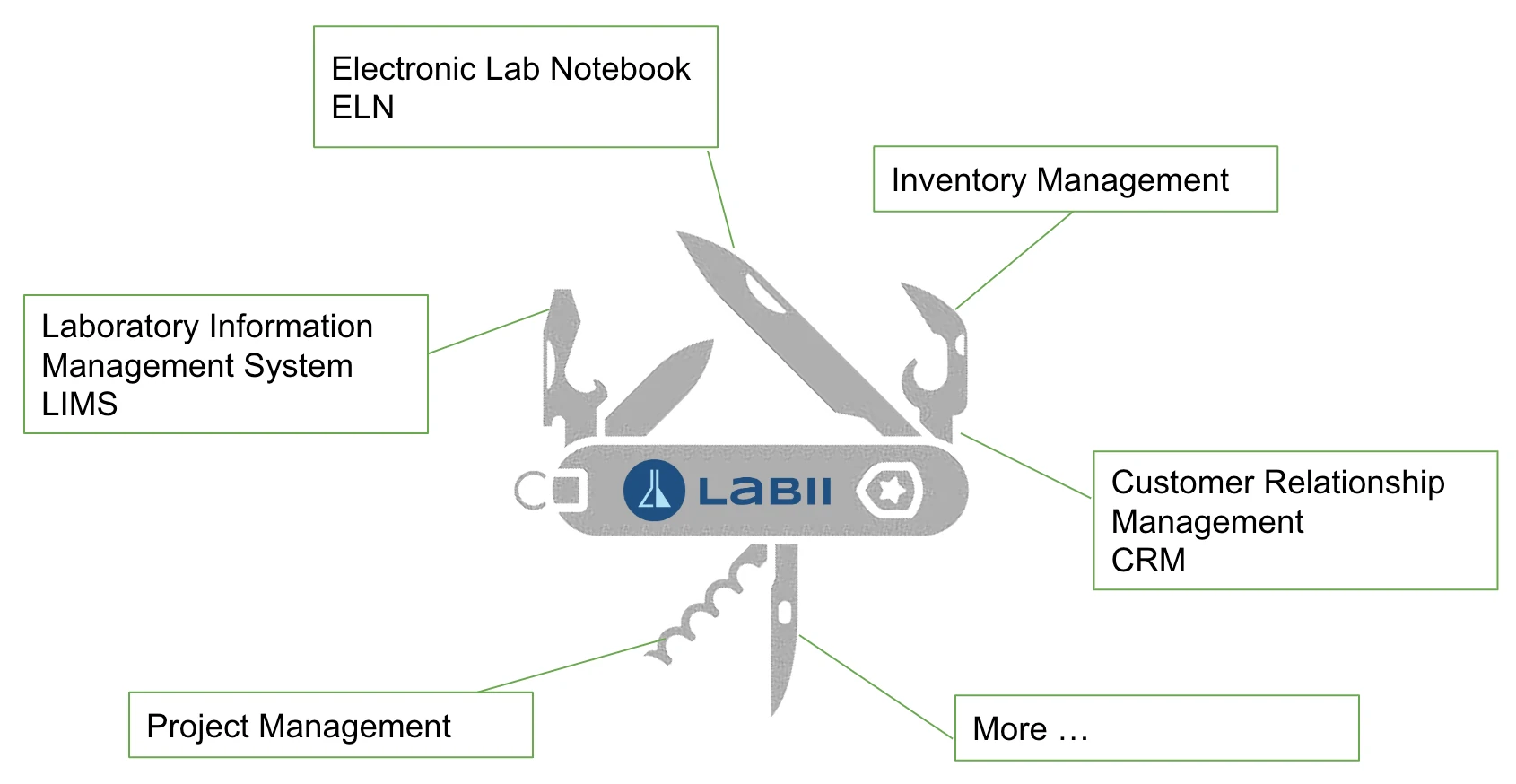
Labii's Agricultural Research Manager (ARM) integrates seamlessly with our broader product ecosystem to provide end-to-end solutions for agricultural research companies. From upstream R&D with ELN and LIMS capabilities, to field trial management with ARM, to inventory control with our Inventory Management system—each product works together to create a unified platform for your complete research operation. Whether you're developing new formulations in the lab or testing products in the field, Labii provides the tools you need for success.
Ready to Build Your Own Scientific Applications?
See how Labii can transform your research management. Schedule a live demo or start configuring your system today. Whether you’re looking for a complete ELN/LIMS replacement or building your own lab workflows, Labii gives you everything you need to start fast and scale smart.
Refer a company to Labii and earn free months for each seat they sign.